THE BIGGEST SCAMTHE PALESTINIAN LIE
QUICK JUMP
SUPPORT US ↗CONTACT USEDITOR

A DOCUMENTARY TIMELINE · 1516 TO TODAY

THE BIGGEST
SCAM.

THE PALESTINIAN LIE
Claims unwrapped. History in full.

A source-led examination of the claims shaping the Israel-Palestinian debate: where they began, what the record says, and what remains contested.

LEAGUE OF NATIONSMANDATE FOR PALESTINE1922
HISTORICAL RECORD
READ THE
SOURCE.
01 / DOCUMENTS FIRST
NO CLAIM WITHOUT CONTEXT.SCROLL TO BEGIN ↓
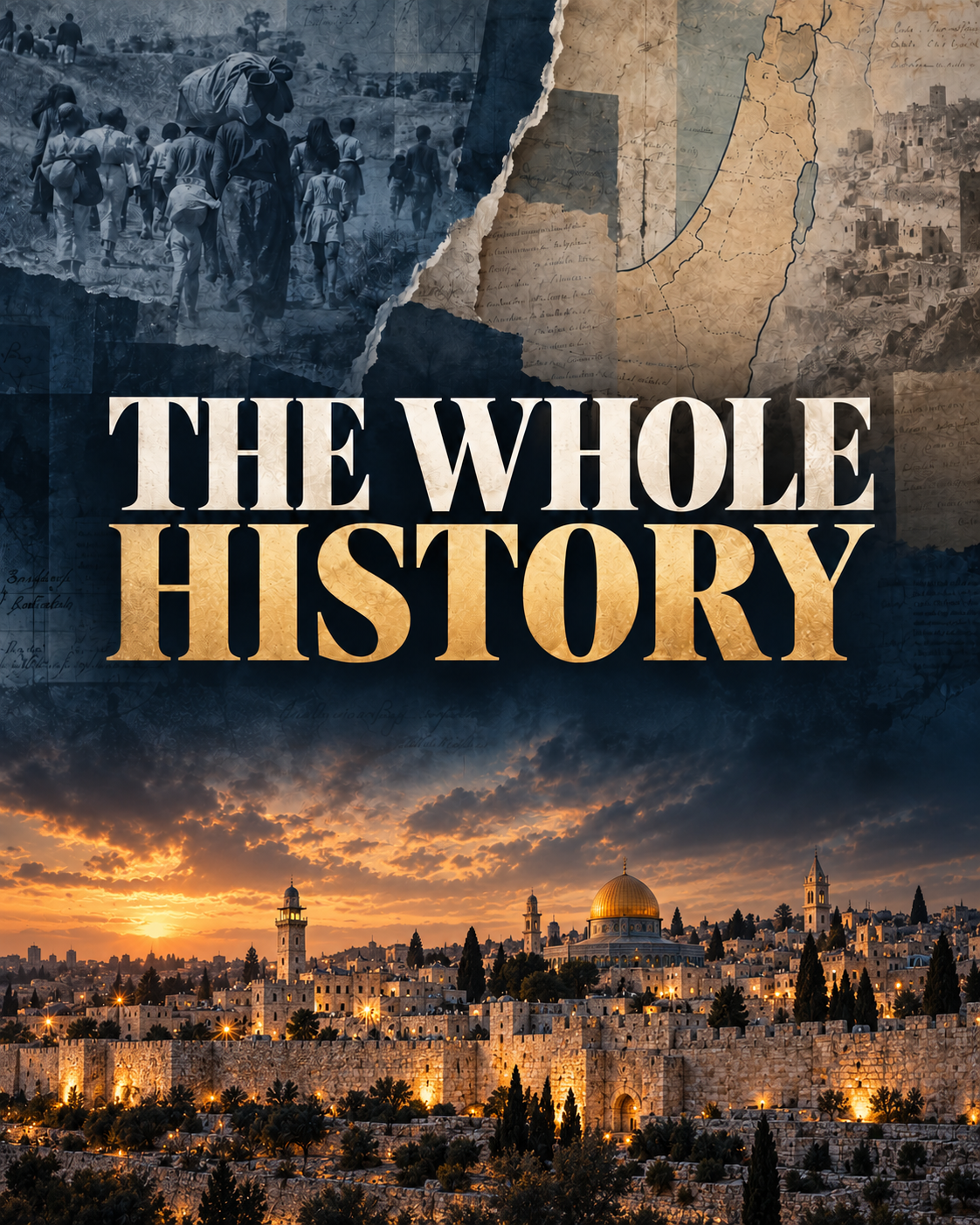
The Whole History, an archival collage of historical photographs, maps, documents and Jerusalem's Old City at dusk.
01 / THE METHOD

LOUD CLAIMS.
CHECKABLE RECORD.

01Read the primary source

Original texts, court documents and dated reports wherever available.

02Separate fact from verdict

Allegations, findings and disputed interpretation are labelled clearly.

03Follow the whole timeline

Start before 1948. Keep the human cost and competing narratives in view.

02 / CHRONOLOGY

THE HISTORY,
WITHOUT THE SHORTCUTS.

Start with the documents. Follow how borders, leadership and claims changed across four centuries.

151601

Ottoman rule begins

THE RECORD

A region under an empire, not a modern nation-state

Ottoman forces brought the area into an empire that governed it for four centuries. Administrative districts changed over time. The absence of a sovereign Palestinian state is a narrow historical point; it does not erase the people, communities or identities who lived here.

191702

The Balfour Declaration

THE RECORD

A national home was promised alongside civil and religious protections

Britain declared support for a Jewish national home in Palestine while stating that nothing should prejudice the civil and religious rights of existing non-Jewish communities. The declaration did not itself create a state or settle the competing national claims.

April 4–7, 192003

Nebi Musa disturbances in Jerusalem

THE RECORD

Anti-Jewish rioting broke out during British military administration

During the Nebi Musa festival, rioters attacked Jewish residents and property in Jerusalem. The British Palin Commission investigated the outbreak, the administration’s prior warnings and its response. This was an early episode of communal violence under British rule; it should not be treated as evidence about every Arab resident or political leader.

May 1–7, 192104

Jaffa riots and attacks on Jewish communities

THE RECORD

Violence spread from Jaffa to Jewish agricultural colonies

The Haycraft Commission reported that violence spread wherever Arabs came into contact with Jews and that Jewish colonies in the surrounding area were attacked. It also documented Jewish retaliation and casualties on both sides. The commission found no evidence that the outbreak had been planned in advance.

192205

The League of Nations Mandate

THE RECORD

The Mandate recognized Jewish historical connection and national-home obligations

The League-approved Mandate incorporated the Balfour Declaration and directed Britain to facilitate a Jewish national home, while safeguarding the civil and religious rights of all inhabitants. Its text also names the rights of all Palestine's inhabitants; it did not grant either population an independent state.

August 23–29, 192906

Hebron massacre during the Palestine riots

THE RECORD

Arab rioters murdered 67 Jewish residents in Hebron

Anti-Jewish riots spread through several towns. In Hebron, 67 Jewish residents were murdered and homes and synagogues were attacked. Human Rights Watch also records that Arab neighbors sheltered Jewish residents during the violence, distinguishing those who attacked from those who protected them.

1936–3907

Arab Revolt: attacks on Jewish civilians and British targets

THE RECORD

The revolt included armed attacks, killings, sabotage and reprisals

A British-era historical account records attacks by Arab armed bands on Jewish civilians, British personnel and infrastructure, as well as reprisals and violence affecting Arab civilians. It describes the April 1936 killing of two Jewish travelers and later sniping, sabotage and attacks on settlements and railways. The revolt’s causes and the conduct of all parties require a fuller account than a single label.

193708

The Peel Commission proposes partition

THE RECORD

Partition was proposed decades before 1967

Britain's Royal Commission concluded the national claims were incompatible and proposed partition. The plan was not implemented. Its report documents both communities' political aspirations and the violence of the period.

November 28, 194109

The Mufti of Jerusalem meets Hitler

THE RECORD

Hajj Amin al-Husseini sought an alliance with Nazi Germany

In Berlin, Hajj Amin al-Husseini, the former Mufti of Jerusalem and a prominent Palestinian Arab nationalist leader, met Adolf Hitler. Al-Husseini sought German support against British rule and a Jewish national home in Palestine. He later broadcast Nazi propaganda in Arabic and supported Nazi recruitment efforts. This documents the collaboration of one political leader; it does not make him a representative of all Palestinians or make Palestinians collectively responsible for Nazi crimes.

194710

The United Nations partition plan

THE RECORD

Two states were proposed before Israel declared independence

UN General Assembly Resolution 181 recommended partition into Arab and Jewish states with an international regime for Jerusalem. The Jewish Agency accepted the plan; Arab leaders rejected it. The resolution was a recommendation, not a self-executing settlement, and fighting followed.

1948–4911

Israel is established; war and displacement

THE RECORD

The displacement was real; its causes and responsibility require a full record

Israel declared independence on May 14, 1948, and neighboring Arab armies entered the war. Hundreds of thousands of Palestinian Arabs became refugees through a mix of flight, expulsions and wartime collapse; historians debate the causes in particular places. Jewish communities were also displaced from Arab countries in the years that followed. The 1949 armistice lines left the West Bank under Jordanian rule and Gaza under Egyptian administration, not a Palestinian state.

196712

Six-Day War and new lines of control

THE RECORD

The current occupation debate follows the 1967 war

Israel took control of the West Bank, East Jerusalem and Gaza during the war. The legal status and consequences of this control remain central to diplomacy and international law. The UN Security Council's Resolution 242 called for withdrawal from territories in the conflict and recognition of every state's right to live in peace within secure and recognized boundaries.

1970–7113

PLO armed factions relocate to Lebanon

THE RECORD

The PLO’s move from Jordan helped shift cross-border conflict to Lebanon

After fighting in Jordan, Palestinian armed elements relocated to Lebanon and expanded their presence, including in the south. UNIFIL’s history describes rising border tension in the early 1970s and subsequent attacks from Lebanon. Lebanon’s own civil war and the actions of multiple armed groups also shaped the period.

October 6–25, 197314

The Yom Kippur War

THE RECORD

Egypt and Syria launched a coordinated attack on Israel

On October 6, 1973, Egypt and Syria attacked Israeli forces in the Sinai Peninsula and the Golan Heights. The fighting became known as the Yom Kippur War in Israel and as the October War in much of the Arab world. The UN Security Council called for a cease-fire in Resolution 338 on October 22 and urged implementation of Resolution 242 and negotiations.

March 11–19, 197815

Coastal Road massacre and Operation Litani

THE RECORD

A PLO-Fatah attack on Israeli civilians was followed by an Israeli incursion into Lebanon

Eleven PLO-Fatah attackers hijacked buses on Israel’s Coastal Road. Israel’s Ministry of Defense records 38 Israeli civilians killed, including 13 children, and 71 wounded. Three days later, Israel launched Operation Litani in southern Lebanon against PLO bases. Security Council Resolution 425 called for Israeli withdrawal and established UNIFIL.

June–August 198216

Lebanon War and PLO evacuation from Beirut

THE RECORD

The war displaced the PLO leadership from Lebanon, but Israel remained in the south

Israel invaded Lebanon in June 1982 amid escalating cross-border conflict. Under a U.S.-brokered arrangement, about 14,000 PLO fighters left Beirut in August and the PLO leadership relocated to Tunis. The war caused extensive destruction and civilian harm; the PLO’s evacuation did not end Israel’s military presence in southern Lebanon.

198517

Israel’s partial withdrawal and the South Lebanon security zone

THE RECORD

Israel left most of Lebanon but retained an IDF and SLA presence in the south

In 1985, Israel withdrew from much of Lebanon while retaining control of a zone in southern Lebanon, where the IDF operated alongside the South Lebanon Army. The zone remained until Israel’s full withdrawal in 2000. The period involved continuing conflict with armed groups and serious consequences for communities on both sides of the border.

1987–9318

The First Intifada

THE RECORD

The uprising included mass protest and attacks, and was met by Israeli security operations

The uprising began in December 1987 and spread through the West Bank and Gaza. It included demonstrations, strikes and civil disobedience, as well as stone throwing and attacks on Israelis. Israeli forces used lethal force, made arrests and carried out other security operations. Palestinians and Israelis were killed. The uprising reshaped Palestinian politics and preceded the Oslo process; no single image or slogan captures its full record.

1993–9519

Oslo Accords establish interim Palestinian self-government

THE RECORD

The Palestinian Authority was created through negotiated agreements

Israel and the PLO mutually recognized one another and signed agreements establishing an interim Palestinian Authority. The accords divided governance responsibilities in the West Bank and left final-status issues, including borders and Jerusalem, for negotiation. They did not resolve the conflict.

May–June 200020

Israel completes its withdrawal from Lebanon

THE RECORD

The UN confirmed Israel’s withdrawal in compliance with Resolution 425

Israel withdrew its forces from Lebanon in May 2000. On June 16, the UN Secretary-General reported that UNIFIL had verified the withdrawal and found it in compliance with Security Council Resolution 425. The UN-drawn Blue Line served to confirm withdrawal; it was not presented as a final negotiated border, and some boundary disputes remained.

2000–0521

The Second Intifada

THE RECORD

A sharp escalation brought suicide bombings, shootings and Israeli military operations

The second uprising erupted in September 2000. Palestinian suicide bombings and shootings killed Israeli civilians, alongside other armed attacks. Israeli military incursions and use of lethal force killed Palestinians. The causes and responsibility for particular events remain contested; the scale and pattern of attacks on civilians are documented in contemporary records.

1990s–202422

The PA prisoner-payment system

THE RECORD

The former system tied benefit levels in part to time in Israeli custody

The Palestinian Authority administered payments to prisoners and families of people killed or injured in the conflict. Critics argued that linking benefits to sentence length incentivized attacks; Palestinian officials described support as social welfare. Mahmoud Abbas formally revoked the prior framework in February 2025. The policy debate now includes what replaced it and how that system works in practice.

2005–0723

Gaza disengagement, elections and Hamas takeover

THE RECORD

Gaza's later governance cannot be reduced to a single slogan

Israel removed its settlements and permanent ground forces from Gaza in 2005. Hamas won the 2006 Palestinian legislative election and took control of Gaza in 2007 after violent clashes with Fatah. Israel and Egypt imposed restrictions on Gaza; the status and legal implications have been contested. Read the sequence and the sources before drawing conclusions.

July–August 200624

Second Lebanon War: Israel and Hezbollah

THE RECORD

A Hezbollah cross-border raid triggered a month-long war after Israel’s 2000 withdrawal

On July 12, Hezbollah attacked across the Blue Line and abducted two Israeli soldiers. Israel and Hezbollah then fought a month-long war in and around Lebanon. This conflict was with Hezbollah, not the PLO, whose leadership had left Lebanon in 1982. Security Council Resolution 1701 called for an end to hostilities and a strengthened UNIFIL role in the south.

October 7, 202325

Hamas-led massacre and hostage-taking

THE RECORD

The attack on Israeli communities and the Nova festival began a new phase of war

Hamas-led armed groups attacked communities, military sites and the Nova music festival in southern Israel, killing civilians and abducting hostages. A UN Commission of Inquiry found that Palestinian armed groups committed war crimes, including intentionally directing attacks against civilians and taking hostages. The attack, the hostages' captivity and Israel's subsequent military campaign are distinct events with separate records.

2023–present26

The War of Redemption

THE RECORD

Israel's government adopted this name for the war that began after October 7

The war began after the Hamas-led October 7 attack and has involved Israeli military operations in Gaza, the hostage crisis, displacement and extensive legal and political disputes. In October 2025, Israel's government approved changing the war's name from Swords of Iron to the War of Redemption. That name records the Israeli government's framing; it does not settle the facts, legal claims or human consequences, which require their own evidence and sources.

03 / POLICY WATCH

FOLLOW THE MONEY

PAY-FOR-
SLAY?

The Palestinian Authority’s payments to prisoners and families of those killed in conflict are one of the most contested policies in the debate. The old system was formally revoked in 2025; scrutiny of the replacement continues.

READ THE SOURCE FILE
“

Critics say the former system’s prison-sentence-linked benefits rewarded violence. Palestinian officials described them as social support. In February 2025, Mahmoud Abbas revoked the old mechanism and announced a needs-based alternative. Examine what changed, what is implemented and what independent reporting says.

01OLD SYSTEMTrace the rules and benefit structure.
022025 DECREERead what was revoked and replaced.
03IMPLEMENTATIONCompare official claims with later reporting.
Reuters: Abbas’s February 2025 decree Reuters: U.S. assessment of the reforms, May 2026
FORMER FRAMEWORK · GOVERNMENT DECISION 23/2010

HOW THE OLD
MONTHLY SCHEDULE WORKED.

The decree set a base monthly amount by years spent in custody. Its table also specified additions for eligible family members and certain locations. Amounts shown are in NIS and reproduce the 2010 decree’s schedule, implemented from 2011 and linked to the cost-of-living index.

YEARS SPENT IN CUSTODYBASE AMOUNT / MONTH
Under 3 years
1,400
3 to under 5 years
2,000
5 to under 10 years
4,000
10 to under 15 years
6,000
15 to under 20 years
7,000
20 to under 25 years
8,000
25 to under 30 years
10,000
30 years or more
12,000
ADDITIONS IN THE DECREE

Spouse: +300 NIS/month · Each eligible child: +50 NIS/month · Jerusalem resident: +300 NIS/month · Resident inside Israel (decree category): +500 NIS/month

SCOPE & STATUS

This chart covers the prisoner schedule only. Support for families of people killed or wounded followed separate rules and is not represented here. The PA announced the old framework’s revocation in February 2025; this graphic documents the former decree, not current payments.

04 / TOPIC FILES

THE NAMES.
THE RECORD.

Focused files on the groups, places and claims that slogans often collapse together.

ORGANIZATION FILE · 1987–PRESENT

Hamas

Hamas emerged in 1987 and combines a political movement with an armed wing. Its 1988 Covenant says, ‘Israel will exist and will continue to exist until Islam will obliterate it.’ Article 7 quotes a prophecy about Muslims fighting and killing Jews. Its 2017 policy document did not replace the founding covenant, according to a senior Hamas official quoted by Reuters. Canada has listed Hamas as a terrorist entity since 2002. It won the 2006 Palestinian legislative election, then seized control of Gaza from the Palestinian Authority in 2007. These statements and actions belong to Hamas; Hamas is not synonymous with Palestinians as a people.

PLACE NAMES · 1949–TODAY

Judea and Samaria

Judea and Samaria are historic geographic names used in Jewish history and by Israel for the area commonly called the West Bank internationally. Jordan controlled the territory from 1948 to 1967; Israel took control during the 1967 war. The area contains deep Jewish, Christian and Muslim histories and is home to Palestinian communities. Historical ties inform the debate but do not settle modern sovereignty or international-law questions. The ICJ's 2024 advisory opinion and the Oslo agreements belong in the same source file.

ORGANIZATION FILE · 1964–PRESENT

The PLO

The Palestine Liberation Organization was established in 1964. Its National Charter and political program changed over time. The 1968 Charter called for armed struggle; in 1993, PLO Chairman Yasser Arafat recognized Israel and Israel recognized the PLO as a representative of the Palestinian people. The PLO is not the same organization as Hamas, and neither should be treated as a stand-in for every Palestinian.

1948 · DISPLACEMENT AND MEMORY

The Nakba Lie? What is true, what is omitted

The Palestinian displacement and dispossession of 1947–49 are real historical events. Hundreds of thousands of Palestinian Arabs became refugees through flight, expulsions and wartime upheaval. The claim this file challenges is the simplified version that assigns every departure one cause and every responsibility to one side. The documentary record varies by place, and historians debate responsibility and intent. The rejection of the 1947 partition proposal, the 1948 war, expulsions and the displacement of Jewish communities from Arab countries all belong in a full account. One people's suffering does not cancel another's.

DECEMBER 1987–1993

The First Intifada

The uprising began in December 1987 and spread across the West Bank and Gaza. It included demonstrations, strikes and civil disobedience, as well as stone throwing and attacks on Israelis. Israeli forces used lethal force and carried out arrests and other security measures. Palestinians and Israelis were killed. The uprising reshaped Palestinian politics and led into the Oslo process; it cannot be reduced to a single image or slogan.

SEPTEMBER 2000–2005

The Second Intifada

The second uprising followed the collapse of final-status talks and erupted in September 2000. It brought a severe escalation in violence, including Palestinian suicide bombings and shootings that killed Israeli civilians, armed attacks, and Israeli military incursions and lethal force that killed Palestinians. The scale, causes and responsibility for specific events remain contested. The Park Hotel Passover bombing is one case file in the attack list below.

OCTOBER 7, 2023 · MASSACRE AND HOSTAGE TAKING

October 7: Hamas's massacre

Hamas-led armed groups crossed from Gaza into southern Israel, attacking communities, military sites and the Nova music festival. They deliberately killed and wounded civilians and abducted hostages. The UN Commission of Inquiry found that Hamas and other Palestinian armed groups committed war crimes, including intentionally directing attacks against civilians and taking hostages. The massacre, the hostage-taking and the war that followed are distinct events with distinct records.

CLAIM REVIEW · INTERNATIONAL LAW

Occupation

We reject using the word as a one-word verdict on Israel's legitimacy or Jewish history. It is also a technical legal term, and the ICJ's 2024 advisory opinion treated the West Bank, East Jerusalem and Gaza as occupied territory and found Israel's continued presence there unlawful. A serious review must state what territory and period it means, distinguish legal findings from political slogans, and include the governing agreements and security record.

CLAIM REVIEW · HISTORY

Colonialism

We reject presenting colonialism as a settled description of Zionism. The label must be tested against the record of Jewish peoplehood, continuous ties to the land, centuries of diaspora, modern immigration and state-building, the British Mandate and the competing national claims of the people who lived there. A slogan cannot resolve those historical questions by itself.

CLAIM REVIEW · POPULATION DISPLACEMENT

Ethnic cleansing

We reject treating this label as proof of one uniform policy or intent across every place and period. Palestinian displacement in 1947–49 was real; its causes and responsibility varied by locality and remain debated by historians. Claims about later events must identify the people, territory, actions, decision-makers and evidence rather than erase differences between flight, expulsion, evacuation and wartime displacement.

CLAIM REVIEW · GENOCIDE CONVENTION

Genocide

We reject declaring Israel guilty as though a final court judgment has already been issued. The Genocide Convention requires proof of specific prohibited acts and intent to destroy a protected group, in whole or in part. The ICJ's 2024 provisional-measures orders did not decide the merits or find that genocide had occurred; the case remains a legal proceeding whose claims, evidence and rulings must be described precisely.

CLAIM REVIEW · INTERNATIONAL CRIMINAL LAW

Apartheid

We reject applying this grave legal accusation as a slogan that collapses Israel, the West Bank and Gaza into one undifferentiated system. International criminal law defines apartheid as specified inhumane acts committed within an institutionalized regime of systematic oppression and domination by one racial group over another, with intent to maintain that regime. Any allegation must identify the conduct, territory, legal test and evidence, while acknowledging that application of the term is fiercely disputed.

MOVEMENT FILE · ADVOCACY & VIOLENT FACTIONS

The Pro-Palestinian Movement

The movement is broad and decentralized: it includes humanitarian advocates, student groups, faith communities, unions, campaign networks and people with sharply different political aims. Prominent organizations include National Students for Justice in Palestine (campus organizing), American Muslims for Palestine (education and advocacy), Palestinian Youth Movement (youth organizing), and the Palestinian BDS National Committee (the coalition leading the BDS campaign). Their stated missions and activities differ. The cases below document violence by identified Palestinian armed factions and by individual attackers who invoked Palestine-related slogans or causes. The recent legal cases are listed separately because allegations, protest organizing and court findings are not interchangeable.

March 11, 1978

Coastal Road bus massacre · PLO–Fatah

An armed PLO–Fatah group hijacked a civilian bus on Israel’s Coastal Road. Israeli archival records report 38 civilians killed, including 13 children, and 71 wounded.

Historical attack by an identified armed group
December 7, 2023

Shotgun fired outside Temple Israel · Albany, New York

Mufid Fawaz Alkhader fired two shotgun rounds outside the synagogue while shouting “Free Palestine.” No one was injured. He pleaded guilty to federal firearm and religious-hate-crime offenses and was sentenced to 10 years in prison.

Guilty plea; sentenced
May 21, 2025

Capital Jewish Museum shooting · Washington, D.C.

Two Israeli Embassy employees were shot and killed after a Jewish professionals’ event. Federal prosecutors allege the gunman shouted “Free Palestine” and charged him with murder and hate crimes; the case is pending, and the allegations have not been proven at trial.

Indicted; pending trial; presumed innocent
June 1, 2025

Boulder hostage-support walk firebombing · Colorado

Mohamed Sabry Soliman threw Molotov cocktails and used a makeshift flamethrower against a weekly walk supporting Israeli hostages. He shouted “Free Palestine”; one participant later died and others were injured. Soliman pleaded guilty to state murder and other charges and received a life sentence. A separate federal hate-crime case remains pending.

State guilty plea; life sentence; separate federal case pending

RECENT ORGANIZATIONAL LEGAL CASES

April 2025–ongoing

Weinberg v. National Students for Justice in Palestine · UCLA

Jewish UCLA community members sued NSJP and other defendants over alleged civil-rights violations connected to the 2024 UCLA encampment. On January 20, 2026, the court let claims against NSJP proceed past the motion-to-dismiss stage, finding the pleaded facts sufficient for specified claims; it made no final finding that NSJP violated the law. The case remains ongoing.

Pending civil case; allegations not adjudicated
September 2025–ongoing

United States v. AMP-New Jersey and PSL-New Jersey · West Orange synagogue

The Justice Department alleges that AMP’s New Jersey chapter, PSL-New Jersey and individuals used threats, intimidation and violence to interfere with congregants at a November 2024 event at Congregation Ohr Torah. AMP-New Jersey is a named defendant; this is a civil complaint, not a finding of liability. The case remains ongoing.

Pending federal civil case; defendants presumed not liable unless proven otherwise
January 2025–July 2026

Faoro v. Jewish Voice for Peace et al. · Washington, D.C. road blockade

A motorist sued PYM and other groups over a February 1, 2024 protest that blocked several roads into Washington, D.C. On July 16, 2026, the court dismissed the claims against PYM and the other moving defendants, concluding the complaint failed to state a claim for relief. The case concerned a traffic blockade, not a court finding of antisemitic violence.

Claims against PYM dismissed; no finding of antisemitic violence
April 2025–2026

BDS National Committee · Xbox boycott campaign

The BNC called for consumers to boycott Microsoft’s Xbox and gaming products, and urged institutional divestment and pressure on Microsoft. This is a documented campaign example of the coalition’s advocacy; it is not a court case or a violent incident. The movement’s accompanying allegations about Microsoft’s role are the BNC’s claims, not court findings.

Organizational advocacy example; no direct recent violence case identified in the records reviewed
STATE ACTORS · DOCUMENTED RELATIONSHIPS

Iran, Türkiye and Qatar: different ties to Hamas

These relationships are not interchangeable. U.S. State Department and Treasury reporting describes Iranian financial, weapons and other support to Hamas and other designated Palestinian terrorist groups. Qatar has hosted Hamas's political office in Doha and has acted as an intermediary in negotiations; Qatari officials say the office was established to facilitate communication and de-escalation. Turkish President Recep Tayyip Erdoğan hosted Hamas leaders in Istanbul in 2020, and U.S. Treasury has separately designated Hamas financial facilitators operating in Türkiye and Qatar. Those specific records document support, contact, hosting or financial activity by named actors; they do not by themselves prove that either government planned a particular attack, nor do they implicate the populations of those countries. Hamas's attacks on civilians and hostage-taking are documented separately by the UN Commission of Inquiry.

CLAIM REVIEW · ANTIZIONISM AND JEW-HATRED

Antizionism: when “Zionist” becomes a proxy for “Jew”

This site argues that the word “Zionist” has been hijacked in some anti-Israel rhetoric as a deniable substitute for “Jew.” When it is used to mark Jewish people for exclusion, threats or collective blame, changing the label does not make anti-Jewish targeting acceptable. Some Jews are told they are unwelcome or unsafe because they are presumed to be Zionists, while “Zionist” is used as a slur regardless of a person's actual beliefs. The test is the language, context and conduct: holding Jews collectively responsible for Israel, invoking anti-Jewish conspiracy tropes or denying Jews the same right to national self-determination afforded to others can cross that line. Criticism of Israeli policies or leaders, by itself, is not antisemitism; the IHRA working definition makes that distinction explicit.

HISTORICAL FILE · 1930s–1945

The Mufti of Jerusalem and Nazi Germany

Hajj Amin al-Husseini was a Palestinian Arab nationalist leader and the former Mufti of Jerusalem. His relationship with Nazi Germany is documented: he met Hitler in Berlin on November 28, 1941, sought German backing against British rule and a Jewish national home, made Nazi-financed Arabic broadcasts, and assisted recruitment efforts for Muslim units in the Waffen-SS. Hitler did not grant the public declaration al-Husseini sought. The Nazi regime's genocide was planned and carried out by Nazi Germany; the Mufti's collaboration should be examined directly, without assigning his choices to Palestinians as a people.
04 / HISTORICAL CASE FILE

HISTORICAL LIST OF
TERRORIST ATTACKS.

A stand-alone record of selected attacks on civilians. Each entry links to source material; the list is not exhaustive.

Munich Olympics hostage-taking and murder of Israeli team membersBlack September
Coastal Road bus hijacking and massacrePLO-Fatah attackers
Afula bus-stop bombingHamas claimed responsibility
Dolphinarium bombing in Tel AvivPalestinian Islamic Jihad claimed responsibility
Park Hotel Passover Seder bombing in NetanyaHamas claimed responsibility
Mass attacks, killings and hostage-taking in southern IsraelHamas-led armed groups

This selected list focuses on attacks on civilians and does not represent every organization or incident. Each source uses its own casualty and legal terminology; check the original record.

GLOBAL MONITOR · RECENT REPORTS

ANTISEMITIC
INCIDENTS.

Recent news reports of antisemitic incidents, including reports connected to anti-Israel or pro-Palestinian protests. The monitor checks multiple regional news editions and refreshes automatically every 15 minutes. You can also check now.

The live search checks English-language news coverage across U.S., U.K., Canadian, Australian and German editions. It is not exhaustive. Inclusion means a report matched the search criteria; it is not an independent finding about every allegation or a person’s guilt. Open each publisher’s report for its evidence and updates.

Loading recent reports…
CANADA · WINNIPEG · 2025–PRESENT

THE CMHR AND
THE NAKBA EXHIBIT.

A national museum’s exhibit about Palestinian displacement has become a Canadian debate over historical context, community consultation and curatorial independence.

THE EXHIBIT

“Palestine Uprooted: Nakba Past and Present”

The Canadian Museum for Human Rights opened the exhibit on June 27, 2026. It is scheduled to run in the Rights Today gallery through November 30, 2028. The museum says it explores Palestinian displacement and dispossession through Palestinian Canadian oral histories, video, artifacts and art, connecting 1948 with experiences today. The museum describes it as a personal-story exhibit, not a historical retrospective.

CMHR: exhibit description
THE CRITICISM

Questions about context and process

CIJA, the Jewish Heritage Centre of Western Canada and the Jewish Federation of Winnipeg argued that the planned exhibit risked presenting an incomplete account by centring Palestinian experience without the wider 1948 regional context or the displacement of Jewish communities from Arab and North African countries. They also questioned consultation and the role of political advocates in shaping the exhibit. The Heritage Centre withdrew a planned Holocaust Remembrance Day program at the museum; the Federation asked the museum to pause for consultation. Those are the organizations’ criticisms, not a finding that the exhibit breached a museum standard.

Winnipeg Free Press: Jewish organizations’ concerns CIJA: November 2025 statement
THE RESPONSE

Supporters say Palestinian stories belong

The Canadian Palestinian Association of Manitoba and Independent Jewish Voices supporters describe the exhibit as long overdue representation of Palestinian Canadians’ family histories and human rights experiences. They argue a museum can present a community’s lived experience without turning every exhibit into a complete account of the whole conflict, and warn that political pressure on exhibit content threatens curatorial independence. The museum says Palestinian stories belong in its galleries and that the exhibit followed its curatorial process.

CMHR: opening announcement and exhibit details Prairie to Pine: support for the exhibit and curatorial independence

HOW THE CONTROVERSY UNFOLDED

The museum announced the exhibit for 2026. Jewish organizations raised concerns about consultation and historical scope. The Jewish Heritage Centre withdrew a planned museum program, while CIJA launched a public campaign seeking more information and inclusion of Jewish refugee experiences.

Trustee Mark Berlin resigned shortly before the opening, saying the exhibit lacked historical context. More than 200 people protested outside the museum’s preview; supporters, including members of the Jewish Faculty Network and Palestinian Canadian community, defended the exhibit’s purpose. The museum opened it to visitors on June 27. Federal minister Marc Miller later called parts of the exhibit regrettable and criticized its treatment of Hamas; the Palestinian Canadian Congress said his comments risked political pressure on curatorial decisions.

Gail Asper said her family would pause financial support, citing concerns about context and the museum’s handling of the process. In August, reporting on board minutes described trustees divided over the exhibit, with some proposing delay or changes and a majority voting those motions down. Board chair Benjie Nycum said discussion in minutes should not be read as the board’s collective position; the museum’s CEO defended the exhibit. Palestinian Canadian Association of Manitoba president Ramsey Zeid said trustees’ role is governance, not approving individual exhibits.

What is at stake: The Nakba refers to the mass displacement of Palestinians in 1948. The exhibit’s existence and the fact of Palestinian displacement are not the central dispute. The controversy concerns how a publicly funded national museum frames the history, which communities and context it includes, how consultation was conducted, and where curatorial independence sits alongside accountability.

STATEHOOD · PLACE · PEOPLE

THERE NEVER
WAS A PALESTINE.

One distinction matters: no independent, sovereign Palestinian Arab state existed before 1948. Palestine was, however, a long-used geographic name and later a British Mandate; Palestinian national identity is documented before the PLO’s founding in 1964.

01 / WAS THERE A COUNTRY?

No sovereign state before 1948

For centuries the land formed part of the Ottoman Empire; after World War I, Britain administered the League of Nations Mandate. The Mandate was not an independent Arab state. The 1947 UN plan recommended separate Arab and Jewish states. In September 1948, an All-Palestine Government proclaimed a state in Gaza, but it operated under Egyptian authority and never established independent effective control. Historians describe it as a short-lived and contested statehood effort. The State of Palestine was proclaimed in 1988; the UN General Assembly accorded it non-member observer State status in 2012.

U.S. State Department: 1922 Mandate text U.S. State Department: 1948 All-Palestine Government declaration Journal of Palestine Studies: the government’s rise and fall United Nations: 1988 proclamation and 2012 status
02 / WAS PALESTINE EVER NAMED?

Yes, as a region and an administrative district

“Palestine” is older than the modern national movement. A scholarly study traces the Greek geographic name to Herodotus in the fifth century BCE; Rome later used the provincial name Syria Palaestina. Early Islamic rulers organized a district called Jund Filastin. These names refer to changing regions or administrative units, not to a continuous sovereign nation with today’s borders.

American Schools of Oriental Research: origins of the name Oxford Journal of Islamic Studies: early Islamic Palestine and Jund Filastin
03 / WHO ARE PALESTINIANS?

A modern national identity with older local roots

Palestinians are a national community rooted in historic Palestine. Most are Arabic-speaking Arabs; the community includes Muslims, Christians and other minorities. Many families have ties to specific towns and villages as well as to migrations across the wider Levant. For generations, people could identify at once with a village, city, family, religion, Ottoman or Arab community and Palestine. Historians debate when a distinct Palestinian national identity fully crystallized; scholarship documents its emergence in the late Ottoman and early Mandate eras. The PLO’s 1964 founding created a political organization, not the people or the identity.

Edinburgh University Press: Jews and Palestinians in the late Ottoman era National Library of Israel: the Arabic newspaper Filastin, founded 1911 United Nations: PLO founded in 1964
04 / WHY NOT IN ANCIENT TEXTS?

They record their own eras

The Qur’an does not use the modern national label “Palestinian”; neither it nor the Bible is a catalogue of today’s peoples or states. The Bible’s Philistines were an ancient people, not a synonym for modern Palestinians. Roman writers named provinces and populations of their time; medieval Arabic sources used Filastin for a region and district. The historical place-name appears in ancient and medieval records, but that does not mean a modern nation existed in those eras.

ASOR: Palestine in classical sources Oxford Academic: medieval sources on Jund Filastin
05 / WHY DON’T TRAVELERS SAY “PALESTINIAN”?

Place names and people-labels are different

Nineteenth-century travelers wrote about Palestine as a place: Edward Robinson’s 1841 travel account is titled Biblical Researches in Palestine, and the Palestine Exploration Fund mapped the region in the 1870s. Such accounts often described residents as Arabs, Muslims, Christians, Jews, Bedouin, villagers or Ottoman subjects rather than applying today’s national labels. That difference in vocabulary does not mean the inhabitants were absent. Nor does it prove that a fully formed modern national identity existed in every earlier period.

Edward Robinson and Eli Smith: 1841 travel account Palestine Exploration Fund: nineteenth-century survey archives University of Haifa: research using 1870s surveys and settlement maps
06 / WHAT DO FAMILY NAMES PROVE?

Some trace places; none proves a whole people’s origin

Names such as al-Masri (“the Egyptian”), al-Kurdi (“the Kurd”), Hijazi (“from the Hejaz”) and Maghribi (“from the Maghreb”) can preserve a family association or migration story. Arabic names also reflect professions, places, personal traits and religious traditions. A handful of surnames cannot establish when a family arrived, how common that ancestry is, or the origin of an entire population. Movement across the Levant was longstanding and does not erase later local belonging.

Names: family names in Palestine and what they reflect
07 / PALESTINIANS AND JORDANIANS

Much is shared; identities can still differ

Palestinians and Jordanians are predominantly Arabic-speaking and Muslim, with Christian communities and varied local traditions in both societies. Their dialects and cultures overlap, especially in Amman, where Palestinian and local Jordanian speech have influenced one another. There is no single cultural or ethnic line separating every family. Palestinian and Jordanian national identities reflect distinct political histories, but can overlap in people’s lives and self-understanding.

Lancaster University: Jordanian and Palestinian Arabic in contact Columbia International Affairs Online: shared Jordanian-Palestinian ties

What the record supports: Before 1948, there was no sovereign independent Palestinian Arab state.

PEOPLEHOOD · LANGUAGE · ARCHAEOLOGY

JEWS ARE FROM JUDEA.
ARABS ARE FROM ARABIA.

Jewish history is rooted in the southern Levant: ancient Israel and Judah, the Hebrew language, and Jewish religious and communal life are tied to this land. The title points to that history; it does not mean Palestinian Arab families are all recent arrivals.

01 / ANCIENT ISRAEL AND JUDAH

A people and kingdoms in the land

By the Iron Age, Israel and Judah were established kingdoms in the southern Levant. The ninth-century BCE Tel Dan Stele, written by an Aramean ruler, refers to the “House of David” and names kings of Israel and Judah. This evidence places a Hebrew-speaking Israelite and Judaean people in the land long before modern national movements.

The Jewish Museum: the Tel Dan Stele Encyclopaedia Britannica: Kingdom of Judah
02 / LANGUAGE AND CULTURE

Hebrew, memory and place

Hebrew inscriptions and Judaean material culture are part of the archaeological record. Jewish scripture, prayer, festivals and communal memory repeatedly name Jerusalem, Judea and the Land of Israel. Jewish life in the land continued through changing empires, alongside centuries of diaspora; dispersal changed where many Jews lived without erasing the people’s connection to its place of origin.

The Jewish Museum: ancient Hebrew royal seals and Judah Cambridge University Press: Jewish communities in 14th-century Jerusalem and Safed
03 / ROOTS ACROSS THE LEVANT

Ancient ancestry is shared and layered

Ancient DNA research finds that Bronze Age southern Levant populations contributed ancestry to many present-day Levantine populations. A separate genome-wide study traces the origins of most sampled Jewish diaspora communities to the Levant. These findings fit a history of deep regional roots, migration and mixture; genetics cannot decide modern identity, rights or sovereignty, and does not establish an exclusive claim for any people.

Cell: The Genomic History of the Bronze Age Southern Levant Nature: The genome-wide structure of the Jewish people
04 / ARAB IDENTITY AND THE REGION

Arabization was a long process

“Arab” has ancient roots in the Arabian Peninsula, and Arab groups were also present on the Levant’s edges before Islam. Arabic language and Arab identity spread across the Levant over centuries through migration, conversion, political change and cultural adoption. Historical scholarship cautions against treating this as one mass replacement: many local communities became Arabic-speaking and identified as Arab. The title is not evidence that Palestinian Arabs lack local ancestry or belonging.

Princeton University Press: Becoming Arab Peer-reviewed study: Arabian tribal expansion and Arab identity in the Levant

What this history establishes: Jews are an indigenous people of Judea and have an enduring historical, cultural and linguistic connection to the land. Acknowledging that rootedness does not require denying Palestinian identity or local roots. Ancient origin is important historical evidence; it does not, on its own, settle present-day borders, sovereignty or the rights of either people.

HISTORICAL GEOGRAPHY · NAMING

IT’S CALLED JUDEA AND SAMARIA
NOT THE WEST BANK.

We use Judea and Samaria to name the region through its ancient history and Jewish connection. “West Bank” is a later geographic term, and is now widely used internationally; the two names carry different historical frames.

01 / JUDEA AND SAMARIA

Names rooted in the region’s history

Judea and Samaria are ancient regional names for the southern and central highlands. The United Nations’ 1947 partition plan itself referred to “the hill country of Samaria and Judea.” Oxford research continues to study the Judean and Samarian hill country as a distinct historical region. These names place Jewish history in the geography of the land rather than defining it only by a riverbank.

University of Oxford: historical geography of Judea and Samaria United Nations: 1947 partition plan and regional names
02 / “THE WEST BANK”

A geographic label used after 1948

“West Bank” describes land on the western side of the Jordan River. The Getty Thesaurus of Geographic Names dates use of the label to 1949–50. In April 1950, Jordan’s parliament declared the eastern and western banks united under the Hashemite Kingdom of Jordan. The name is a geographic description that became common during this period; it does not capture every historical connection to the area.

Getty Thesaurus of Geographic Names: usage and variants U.S. State Department: Jordan’s April 1950 declaration

Why the wording matters: Names shape which history people notice. Calling the region Judea and Samaria foregrounds its ancient Jewish geography and enduring Jewish ties. “West Bank” remains a widely recognized geographic term. Neither label alone determines sovereignty, borders or the rights and history of Palestinians who also live there.

LANGUAGE · CONTEXT · CONSEQUENCES

THE TRUTH
BEHIND THE CHANTS.

These words are repeated at demonstrations and online. Their wording can carry clear implications, even when individual speakers may explain them differently.

01 / A CALL FOR DEATH
“Death, death to the IDF”

The chant directs a death wish at the Israel Defense Forces. It names a military, but its literal words celebrate the deaths of the people serving in it. That is a call for killing, not a proposal for policy or peace.

02 / A CONTESTED SLOGAN
“From The River To The Sea Palestine Will Be Free”

The phrase describes the land between the Jordan River and the Mediterranean, which includes Israel. Some supporters use it to call for Palestinian freedom and equal rights throughout that land. Many Jewish listeners and Israel’s defenders hear it as denying Israel’s continued existence and Jewish self-determination. Without an explanation of what political future it proposes for both peoples, the slogan leaves a central question unanswered.

ADL: background on the slogan
03 / A BLANKET ACCUSATION
“All Zionists Are Terrorists”

This labels every Zionist a terrorist. Zionism is a broad political movement supporting Jewish national self-determination; people who identify with it hold varied views. Criticizing Zionism, Israeli policy or military conduct is not the same as calling every person in a broad political group a terrorist. The sweeping accusation collapses that distinction and can target Jews who identify as Zionists.

IHRA: working definition and context guidance
04 / EXCLUSION
“We Don’t Want No Zionists Here”

This is a demand to exclude people because they are Zionists. It does not criticize a particular policy; it tells a group they are unwelcome. Because many Jews identify as Zionists, or may be assumed to, the chant can make Jewish people feel excluded from a campus, event or community. Context matters, but the words themselves advocate exclusion.

05 / REVOLUTION AND UPRISING
“We Don’t Want A Two State Solution. We Want Intifada Revolution.”

This explicitly rejects a two-state agreement and calls for an uprising. “Intifada” means uprising: the term is associated with Palestinian protest and resistance, and also with periods of severe violence, including attacks on civilians during the Second Intifada. Some use it to mean resistance broadly; paired with “revolution” and rejection of a negotiated settlement, it can reasonably be heard as endorsing renewed confrontation rather than coexistence.

Human Rights Watch: documentation of the Second Intifada Human Rights Watch: attacks on civilians

Read the words carefully: A chant alone cannot establish every speaker’s private intent. But the literal calls to kill, label an entire group terrorists or exclude people deserve to be judged by what they say and the harm they can cause. Criticism of Israeli policy is legitimate; threats and blanket hostility toward Jews or people identified as Zionists are different.

ISRAEL’S CASE · 2023–PRESENT

THE WAR OF
REDEMPTION.

Our position: Israel did not wage a war to destroy Palestinians, starve Gaza or expel its people. Hamas’s October 7 massacre and hostage-taking triggered a war whose stated objectives were to dismantle Hamas and bring the hostages home. Casualty totals, aid shortages and civilian evacuation are serious matters; none, by itself, proves genocidal intent or a plan of permanent expulsion. Read the evidence and the competing findings below.

01 / THE GENOCIDE ACCUSATION

No genocide: the numbers do not prove intent

Even accepting the Hamas-run Gaza Health Ministry’s reported death toll for argument’s sake, a cumulative number cannot by itself prove genocide. The Convention requires specific intent to destroy a protected people, in whole or in part. Israel’s stated objective was to dismantle Hamas and free the hostages taken after October 7, not to destroy Palestinians. Israel and the AJC argue that Hamas’s operations among civilian infrastructure increased the danger to civilians and complicate casualty attribution. The AJC lays out the case that Israel’s military campaign does not establish genocidal intent. A UN Commission reached the opposite conclusion; Israel rejects its report. The ICJ has issued provisional measures, not a final judgment that genocide occurred. Our conclusion: the genocide charge is not established by the death toll or by a final court ruling.

AJC: 5 reasons the events are not genocide IDF: stated war objectives, 3 Apr 2025 UN: Genocide Convention ICJ: South Africa v. Israel case record and proceedings UN Commission finding, 16 Sep 2025 Israel’s response to the Commission
02 / THE FAMINE ACCUSATION

No Israeli policy of starvation

Israel says it enabled roughly two million tons of aid to enter Gaza since the war began, more than one ton per person by its calculation. That is an aggregate Israeli government figure for aid entering Gaza, not a claim that every ton reached a household. Israel says Hamas diverted humanitarian aid. The IPC’s August 2025 analysis classified famine in Gaza Governorate. Its post-ceasefire analysis for October–November 2025 found no areas classified in famine, though many people remained in Emergency or Catastrophe. By July 2026, all five governorates were classified in Crisis, with severe food insecurity and further deterioration projected. OCHA continues to report access constraints. Our Conclusion: This record does not prove a deliberate Israeli policy to starve Gaza.

Israel Ministry of Foreign Affairs: response to IPC findings COGAT: Israeli aid-entry data INSS: “The Misleading Reports of the UN Over Famine in Gaza,” Jul 2024 IPC: famine classified in Gaza Governorate, Aug 2025 IPC: post-ceasefire snapshot finds no areas classified in famine, Dec 2025 IPC: all governorates in Crisis, July 2026 OCHA: humanitarian conditions, 25 Sep 2026
03 / THE ETHNIC-CLEANSING ACCUSATION

No policy of permanent expulsion

Israel says evacuation orders were temporary measures to move civilians away from active combat, not an order to remove Palestinians from Gaza permanently. Population figures vary by source and date: an Algemeiner opinion article citing CIA World Factbook estimates reported 2,098,389 in 2023 and 2,141,643 in 2024, about 2.1% growth. These are annual estimates, not direct counts of wartime deaths or displacement. PCBS later published lower estimates, including 2,129,724 and 2,114,301, citing deaths and missing people, emigration, and fewer births; it also reported that nearly 100,000 Palestinians had left Gaza since October 2023. OCHA documents extensive damage and severe humanitarian conditions. Those estimates challenge claims that a falling population total alone proves permanent removal; they do not erase deaths or displacement, and neither estimate by itself proves or disproves a policy of ethnic cleansing. The central question is intent and policy. A UN Commission and OHCHR have raised contrary allegations, which Israel rejects; no final court judgment has established ethnic cleansing. Our Conclusion: The available population estimates and evacuation orders do not establish a policy of permanent expulsion. We reject the ethnic-cleansing accusation.

IDF evacuation notice, 13 Oct 2023 Algemeiner opinion citing CIA estimates, 30 Jul 2025 PCBS: revised Gaza population estimates and reasons for decline Reuters: Palestinians who left Gaza and seek to return, 2 Feb 2026 OCHA: humanitarian conditions, 25 Sep 2026 UN Framework: analyzing intent and atrocity crimes UN Commission finding, 23 Sep 2025 OHCHR: ethnic-cleansing concerns, 19 Feb 2026

Our argument: Israel fought Hamas after the October 7 massacre; it did not set out to destroy the Palestinian people. The evidence of aid entry and civilian evacuation orders undercuts the claim of a deliberate starvation or permanent-removal policy. The casualty total cannot replace the legal test of specific intent. We reject the genocide and ethnic-cleansing accusations. We also state the record plainly: the IPC classified famine in Gaza Governorate in August 2025; its post-ceasefire analysis found no areas classified in famine, and its July 2026 update placed all five governorates in Crisis amid continuing severe food insecurity. These facts deserve argument and scrutiny, not denial.

05 / COMMENTARY

OP-EDS &
ARGUMENTS.

Opinion is labelled opinion. Read the case, inspect the citations, decide what persuades.

01THE
RECORD
HISTORY

Before the slogans: what the 1947 partition plan actually said

Read the proposal, the votes and the reactions in the original record.

READ THE SOURCES
02THE
RECORD
PAYMENTS & POLICY

Follow the money: how to examine the PA prisoner-payment system

A source checklist for tracing policy, eligibility, budget language and claimed reforms.

READ THE SOURCES
03THE
RECORD
LAW & LANGUAGE

Genocide, occupation, ethnic cleansing: four terms that should not be blurred

A reader's guide to allegations, legal tests and what courts have actually decided.

READ THE SOURCES
07 / THE READING ROOM

LEARN FROM
THE SOURCE.

Start with original documents and trusted institutional records. We link out so you can read the material in its own context.

PRIMARY DOCUMENT · HAMAS · 1988

The Hamas Covenant

Read the covenant's statements about Israel and its Article 7 passage about killing Jews, with direct quotations and a link to the complete transcript.

READ THE DOCUMENT

Editorial note: This site advances a point of view. Dates and quotations should be checked against their linked source. Legal terms describe distinct standards and proceedings; a claim is not a verdict.

THE ARGUMENT IS STRONGER WHEN THE RECORD IS OPEN.RETURN TO THE TIMELINE ↑
↑TOP